
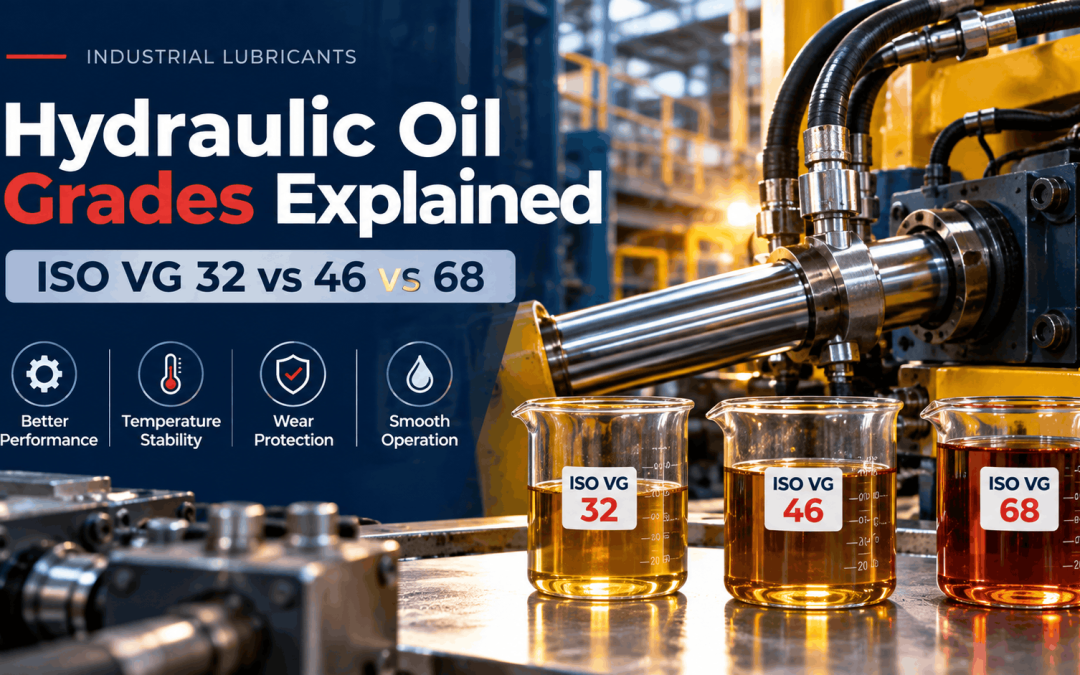
Hydraulic oil plays an essential role in industrial hydraulic systems. It transfers power, lubricates moving components, helps manage heat and protects equipment against wear.
Selecting the correct hydraulic oil viscosity is important for maintaining system performance and equipment reliability. ISO VG 32, ISO VG 46 and ISO VG 68 are common viscosity grades used in industrial hydraulic applications.
1. What Does ISO VG Mean?
ISO VG stands for International Organization for Standardization Viscosity Grade. It classifies industrial lubricants according to their kinematic viscosity at 40°C.
The number indicates the nominal viscosity in centistokes (cSt) at 40°C.
- ISO VG 32: approximately 32 cSt at 40°C.
- ISO VG 46: approximately 46 cSt at 40°C.
- ISO VG 68: approximately 68 cSt at 40°C.
2. ISO VG 32 Hydraulic Oil
ISO VG 32 hydraulic oil has a lower viscosity than ISO VG 46 and ISO VG 68.
It may be suitable for hydraulic systems designed for lower-viscosity oil. Its suitability depends on operating temperature, pump requirements and equipment specifications.
3. ISO VG 46 Hydraulic Oil
ISO VG 46 is a commonly used industrial hydraulic oil viscosity grade. It may be suitable for hydraulic power packs, industrial presses and other equipment designed for this grade.
The correct application depends on the manufacturer's recommendations and actual operating conditions.
4. ISO VG 68 Hydraulic Oil
ISO VG 68 has a higher viscosity than ISO VG 32 and ISO VG 46 at 40°C.
It may be specified for hydraulic systems that require a higher-viscosity oil. However, higher viscosity is not always better, as an unsuitable grade can increase flow resistance.
5. Key Differences Between ISO VG 32, 46 and 68
The primary difference is their nominal viscosity at 40°C.
- ISO VG 32: 32 cSt.
- ISO VG 46: 46 cSt.
- ISO VG 68: 68 cSt.
These grades describe viscosity, not the complete performance of a hydraulic oil. Additives, anti-wear properties and oxidation stability also matter.
6. How to Choose the Right Hydraulic Oil
Before selecting hydraulic oil, consider these factors:
Equipment requirements: Check the manufacturer's recommended viscosity grade.
Operating temperature: Consider both starting and normal operating temperatures.
Pump specifications: Different hydraulic pumps have specific viscosity requirements.
Operating conditions: Pressure, load and duty cycle can influence lubricant selection.
Product specifications: Confirm that the oil meets the required performance standards.
7. Common Hydraulic Oil Selection Mistakes
- Choosing oil based only on price.
- Assuming higher viscosity is always better.
- Ignoring equipment specifications.
- Overlooking operating temperatures.
- Mixing different hydraulic oils without checking compatibility.
Conclusion
ISO VG 32, ISO VG 46 and ISO VG 68 hydraulic oils differ mainly in their viscosity at 40°C. The correct grade depends on equipment design, operating temperature and manufacturer specifications.
Always consult the equipment manual or a qualified lubrication professional before selecting or changing hydraulic oil.
For industrial lubrication enquiries, contact ABS Lubricants to discuss your requirements and available product options.