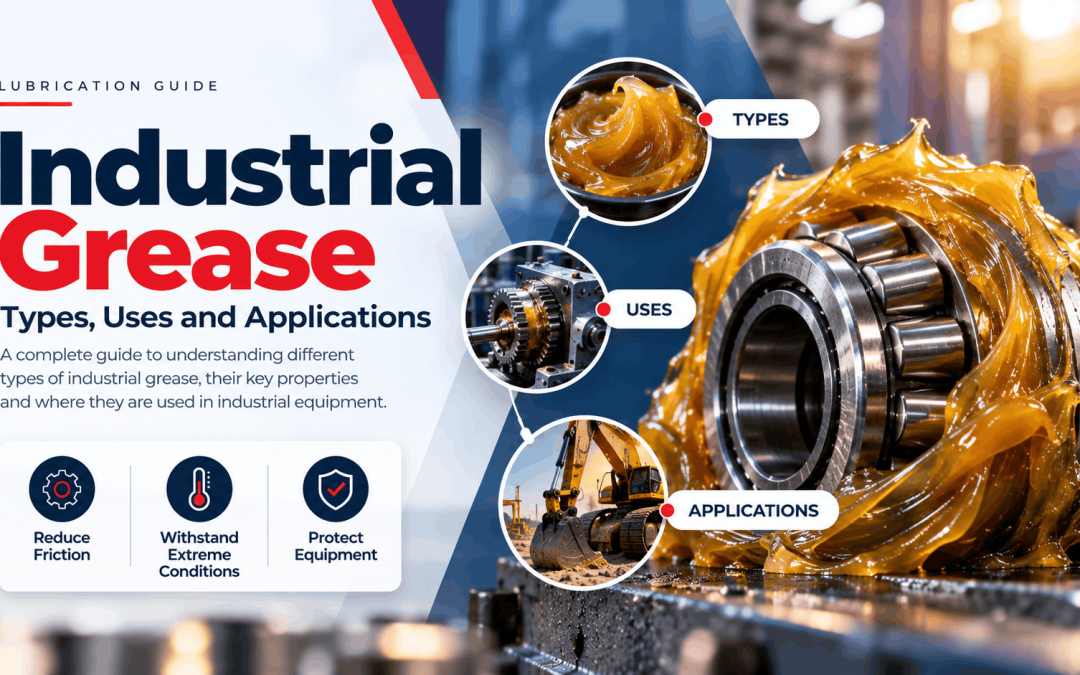
Industrial grease plays an important role in protecting machinery components from friction, wear and contamination. It is commonly used in bearings, joints and other mechanical components where grease lubrication is suitable.
Choosing the right grease depends on equipment requirements, operating temperature, load, speed and environmental conditions.
1. What Is Industrial Grease?
Industrial grease is a semi-solid lubricant generally made from base oil, a thickener and performance additives. It stays in place more effectively than liquid oil in many applications, helping provide lubrication where conventional oil lubrication may not be suitable.
2. Common Types of Industrial Grease
Lithium-Based Grease
Lithium grease is widely used for general-purpose lubrication. Depending on its formulation, it may be suitable for bearings, automotive components and industrial machinery.
Lithium Complex Grease
Lithium complex grease can offer improved high-temperature performance compared with some conventional lithium greases. The actual operating limits depend on the product formulation.
Calcium-Based Grease
Some calcium greases provide good water resistance and are used in applications where moisture protection is important. Their temperature limits depend on the specific formulation.
Polyurea Grease
Polyurea greases are used in selected bearing applications and can provide good oxidation stability and long service life when correctly specified.
3. Where Is Industrial Grease Used?
Industrial grease may be used in several applications, including:
- Electric motor bearings
- Industrial machinery bearings
- Conveyor systems
- Construction equipment
- Automotive and mechanical components
- Selected heavy-duty equipment joints
The correct grease must be compatible with the equipment and its operating conditions.
4. Key Properties of Industrial Grease
Consistency
Grease consistency indicates how firm or soft the grease is. NLGI grades are commonly used to classify consistency.
Temperature Resistance
The grease must be suitable for the equipment's operating temperature and expected thermal conditions.
Water Resistance
Applications exposed to water or moisture may require grease with suitable water-resistance properties.
Load-Carrying Capacity
Heavy loads may require grease formulated with suitable anti-wear or extreme-pressure properties.
Mechanical Stability
The grease should maintain appropriate consistency under the mechanical conditions experienced during operation.
5. How to Choose the Right Industrial Grease
Before selecting a grease, consider these factors:
Equipment specifications: Follow the manufacturer's recommendations.
Operating temperature: Confirm the product's suitable operating temperature range.
Load and speed: Check that the grease is designed for the equipment's load and speed conditions.
Environmental exposure: Consider water, dust and other contaminants.
Compatibility: Avoid mixing different greases unless their compatibility has been confirmed.
6. Common Grease Lubrication Mistakes
- Using an unsuitable grease grade.
- Applying too much or too little grease.
- Ignoring operating temperature and load.
- Mixing incompatible grease types.
- Overlooking maintenance recommendations.
Correct grease selection and application can help improve equipment reliability and reduce avoidable maintenance problems.
Conclusion
Industrial grease helps lubricate and protect machinery components across a wide range of applications. The best choice depends on the equipment, operating conditions and required performance characteristics.
Always consult the equipment manufacturer's recommendations and the grease product datasheet before selecting a lubricant.
Need Help With Industrial Lubrication?
Contact ABS Lubricants to discuss your industrial lubrication requirements and explore suitable product options.